Johannes Halden’s small-cell lung cancer
The SonJohannes Halden’s small-cell lung cancer is an aggressive illness diagnosed too late to treat, and it sharpens the moral reckoning that has defined his life in prison. As his time runs short, Johannes faces both his own concealed betrayal and Arild Franck’s attempt to use access to cancer treatment as leverage against him; the illness becomes the immediate stake in a confrontation over silence, guilt, and the possibility of forgiveness.
Diagnosis and Prognosis
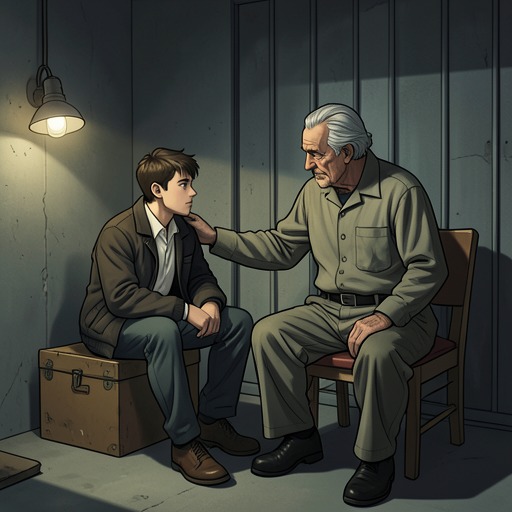
Johannes has spent four years at Staten Maximum Security Prison, where he has settled into the routine of an older, no-longer-threatening inmate: mopping floors, keeping his head down, and exchanging the small favours that make prison life bearable. His illness interrupts that apparent steadiness. A doctor identifies the cancer as small-cell lung cancer, the aggressive form that carries the worst prognosis when it is not caught early. Johannes’s cancer has not been caught early, and there is nothing anyone can do.
The diagnosis is concrete and terminal, not a condition that Sonny Lofthus can reverse through his supposed healing touch. Johannes has asked Sonny about what is wrong, but Sonny does not even come close to identifying the cancer; he speculates instead about Johannes’s groin. The shoulder that had seemed to improve does so of its own accord, not because Sonny’s hand is unusually warm or has healed it. Johannes recognizes this, but does not want to disillusion the young man, whom he regards as good-hearted. The contrast matters: Sonny’s reputation for healing may offer hope, but Johannes’s cancer remains beyond his power.
A Life Measured Against Death
The cancer makes Johannes’s long-kept secrets harder to postpone. He has concealed both his illness and his betrayal, but fears that dying without confessing will leave him unable to rest in peace. He does not hold firm religious beliefs about who is condemned to everlasting suffering or why; nevertheless, he worries that he may wake after death like a worm-eaten, trapped zombie, doomed to eternal torment. That fear does not arise from certainty so much as from the possibility that he has been wrong about too many things in his life.
His sense of time is already closing in: the years have passed into what he understands as a life soon to end. Against that narrowing future stand two promises he once believed might still be fulfilled: the kiss promised by a woman he has forgotten, and the clear conscience promised by a dead police officer. The cancer does not create Johannes’s guilt, but it removes the prospect of indefinitely living around it. His muttered reflection that he has been wrong about so many things gathers the illness, his remorse, and his uncertainty about what follows death into a single unresolved reckoning.
Franck’s Threat
When Sonny’s whereabouts become uncertain, Arild Franck confronts Johannes in his prison bed. Franck grabs him by the neck of his T-shirt and says he knows the guards outside have seen nothing, so Sonny must still be inside. He demands that Johannes disclose where the young man is and threatens to deprive him of cancer treatment if he refuses. Franck has learned of the illness through the reach of his informants, and dismisses doctor–patient confidentiality as no obstacle because, he claims, he has eyes and ears everywhere.
The threat turns treatment into an instrument of prison power. Franck does not merely demand information; he claims the authority to determine whether Johannes receives relief while the cancer advances. He promises to keep him in his cell without so much as a glimpse of pain relief, and says Johannes would not be the first prisoner subjected to that treatment. The illness that has already placed Johannes beyond medical rescue is thus made a means of coercion as well: Franck seeks to make the remaining care Johannes might receive conditional on betraying Sonny.
Refusal and Significance
Johannes answers the threat without trying to bargain. He says that he thinks he has lived long enough, that no one is waiting for him outside, and that his sins have been forgiven; perhaps, he suggests, he should take his chance of getting into heaven while he still can. Franck counters that none of Johannes’s sins has been forgiven and presents himself as a god within the prison, able to ensure a slow, painful death. Johannes accepts the choice Franck is trying to impose and says that such a death would still be preferable to whatever hell awaits the governor.
The exchange brings together Johannes’s physical vulnerability and the moral history he has kept private. Franck treats the cancer as leverage and suffering as punishment; Johannes refuses to let fear of pain make him expose Sonny. His answer does not establish that he has received divine absolution, and the evidence leaves the outcome of his illness unresolved. Instead, it shows how close he has come to accepting death as the last chance to stop hiding from his past—and how, when Franck tries to convert that fear into obedience, Johannes denies him the power to make his silence a bargain.